Once you crack open your mailbox, it’s nearly as in case your letters simply seem. Lengthy earlier than the times of speedy, in a single day mail deliveries, postal service staff meticulously sorted via letters by hand and transported mail on horseback. For greater than 250 years, the US Postal Service has labored behind the scenes to construct a quicker supply community, and this mission has quietly pushed it to the forefront of expertise.
“Most individuals deal with the Postal Service like a black field,” USPS spokesperson Jim McKean tells The Verge. “You are taking your letter, you set it in a mailbox, after which it reveals up someplace in a few days. The reality is that that piece of mail will get touched by lots of people and machines and transported in that time period — it’s a contemporary marvel.”
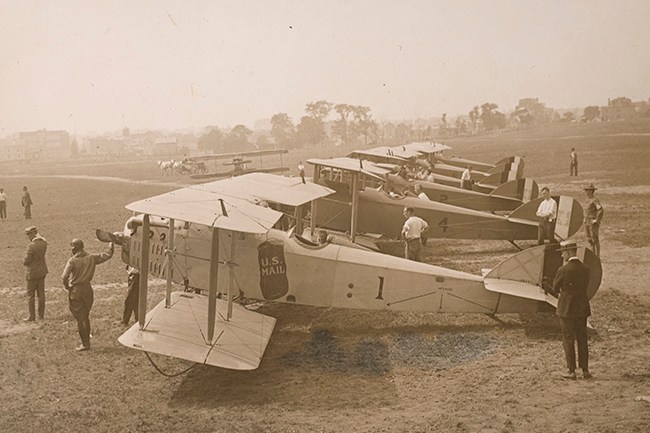
Considered one of its massive breakthroughs came about in 1918 with the introduction of airmail. The USPS labored with the Military Sign Corps to make use of leftover World Struggle I plane to launch the service, and the planes had been as barebones as they might get. An excerpt from a 1968 concern of Postal Life known as the early plane “a nervous assortment of whistling wires” with “linen stretched over wood ribs, all connected to a wheezy, water-cooled engine.”

On the time, pilots actually risked their lives delivering mail — 34 of them died between 1918 and 1927. “There was no business aviation, no airports. There was no radio. There was no navigation,” USPS historian Stephen Kochersperger says. “The Postal Service needed to develop all of these issues only for getting the mail delivered.”
As soon as the USPS established that it may reliably ship mail by aircraft, Congress allowed it to contract airmail service to business aviation firms, laying the groundwork for the foremost airways that we all know at present, like American Airways and United Airways. Together with getting paid for delivering mail, contractors discovered that they might make much more cash by carrying passengers with their cargo. “That was the place business aviation took off,” Kochersperger says.
Airmail routes steadily started to broaden internationally, first to Canada after which to Cuba. However a pair many years later, the USPS experimented with a novel type of supply: mail-by-missile. In 1959, the USPS and the US Navy loaded a Regulus I missile with two mail containers that had 3,000 letters in complete. The missile traveled 100 miles in round 23 minutes, efficiently touchdown at a Navy base in Mayport, Florida, with the assistance of a parachute. Regardless of its success, the thought by no means took off. It seems missiles simply can’t carry that a lot mail. And general, this quite ridiculous demonstration was extra of a stunt to indicate pressure through the Chilly Struggle, in accordance with the Smithsonian.

Again on the bottom, the USPS set its sights on bettering the velocity of mail processing. Although it started experimenting with a mail canceling machine within the Nineteen Twenties, which put a mark on used postage, it wasn’t till the Nineteen Fifties that it deployed an electromechanical sorting machine. As an alternative of manually sorting mail utilizing the “pigeonhole” technique, during which staff would insert items of mail into completely different compartments contained in the put up workplace relying on the tackle, the machine may do this for them.
“The Postal Service is a driver of technological change.”
The Transorma multi-position letter sorting machine measured 13 ft excessive and was break up throughout two ranges. It carried mail on a conveyor belt from its decrease degree to a gaggle of 5 postal staff on the higher degree. The clerks would then use a keyboard to enter details about their vacation spot. Primarily based on the inputted info, the machine would then transport letters to completely different trays and drop them into chutes that introduced them again to the decrease degree. However as the quantity of mail elevated within the years after World Struggle II — going from 33 billion items of mail per yr to 66.5 billion between 1943 and 1962 — the USPS wanted a method to sustain.
For years, the USPS had trusted clerks to memorize dozens of supply schemes that they’d use to kind letters, getting ready them for carriers to distribute all through city. “That modified dramatically in 1963, [with] in all probability the most important innovation the Postal Service has ever rolled out, known as the ZIP code,” Kochersperger says. “For the primary time, mailing lists may very well be digitized in computer systems and sorted in new methods.”
The ZIP code — quick for Zone Enchancment Plan — makes use of its first digit to point which area of the US a parcel is headed, the second and third to sign a close-by main metropolis, and the ultimate two to point a selected supply space. The tempo of innovation on the USPS ramped up following the introduction of the ZIP code, with many subsequent improvements constructing on its basis.

That features the USPS’s adoption of optical character recognition (OCR), a broadly used expertise that converts written or printed phrases into machine-readable textual content. In 1965, the USPS started to ship massive volumes of mail via OCR machines, permitting a “digital eye” to acknowledge addresses and mechanically kind letters. If the machine couldn’t make out an individual’s handwriting, the USPS would ship a picture to a distant encoding heart (REC) for human assessment.
At one level, the USPS had as many as 55 RECs, however now just one stays in Salt Lake Metropolis, Utah. “As our pc methods have gotten higher at recognizing handwriting, we’ve gotten to the purpose the place it’s considerably diminished the variety of letters that need to go to distant coding,” McKean says. At the moment, the USPS’s OCR expertise can learn handwritten mail at almost 98 % accuracy, whereas machine-printed addresses bump its accuracy to 99.5 %.
That’s due to advances in machine studying, which the USPS, too, has been utilizing within the background for greater than 20 years; it first began utilizing a handwriting recognition instrument in 1999. The USPS is at the moment in the course of a 10-year modernization plan, which incorporates investments in expertise, similar to AI. Nonetheless, the plan has confronted criticism for elevating the worth of stamps and inflicting service disruptions in some areas.
“The Postal Service is a driver of technological change,” McKean says. “It’s laborious to overstate the quantity of expertise that the Postal Service has been concerned in both popularizing or innovating over the past 250 years.”